A VR training system is most useful when it is used within a structured program. Without a plan, sessions may not build on each other, and it becomes difficult to show whether performance has improved.
This article outlines a framework for a progressive training program using KOMINA, the virtual training platform for military and law enforcement developed by Komando Imersif Indonesia. The framework is an example. Each unit should adapt it to its own doctrine, standards and schedule.
Start With Objectives
KOMINA describes the first step of its training process as scenario design: defining target objectives, rules of engagement, team composition and opposing threats. A training program can follow the same approach.
For each phase, define what trainees should be able to do and how it will be measured. KOMINA’s after-action review provides metrics that can be used as criteria:
- Shot accuracy and grouping
- Reaction time
- Decision-making speed
- Threat identification time
- Tactical positioning
- Communication efficiency
- Team synchronisation
Record a baseline session for each trainee before the program begins.
Phase 1: Weapon Handling and Movement
Focus: individual skills.
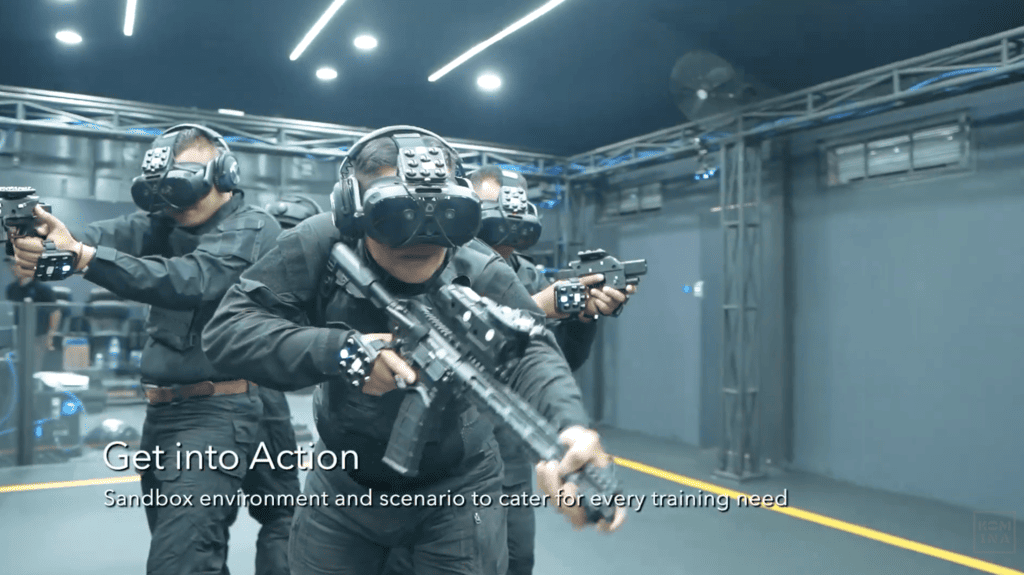
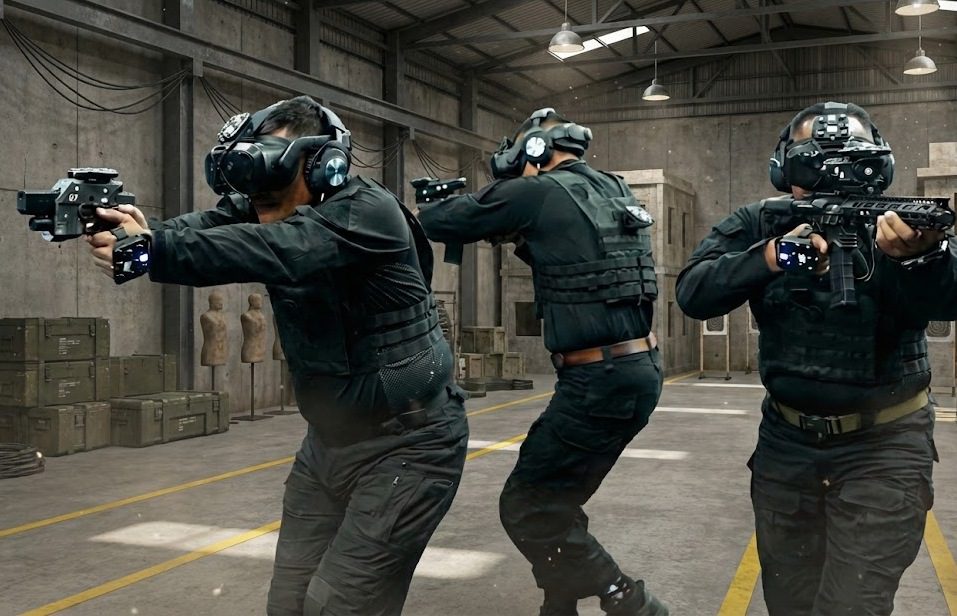
Trainees practise moving in the free-roam VR space, handling modified airsoft weapon props, reloading and drawing from the holster. KOMINA’s armory lists magazine reload mechanics, adjustable fire modes for rifles, and holster integration for pistols.
Use simple environments built in the map editor, with few obstacles and clearly identifiable targets.
Possible criteria: consistent shot grouping, safe weapon handling and stable reaction times across sessions.
Phase 2: Decision-Making
Focus: individual judgement.
Add civilian agents with panicked, compliant and unpredictable behaviour alongside hostile agents. Trainees must assess each person before acting.
Main measures: threat identification time and errors involving civilians. Heart rate monitoring can be introduced in this phase so instructors can review how stress affects decisions.
Possible criteria: fewer civilian-related errors without an increase in identification time.
Phase 3: Small Team Operations
Focus: coordination.
Trainees work in pairs or small teams. Suitable pre-built scenarios include Building Clearance (rated medium) and Close Quarters Battle (rated high). Instructors observe formation, sector coverage and communication.
The top-down view and movement pattern analysis show how the team moves as a unit.
Possible criteria: improved team synchronisation and communication efficiency, and fewer uncovered areas in heatmaps.
Phase 4: Complex Scenarios
Focus: performance in demanding conditions.
Use scenarios with higher difficulty ratings, such as Hostage Response (rated very high) and Drug Raid Operations (rated high). Increase pressure with ambush hostiles, changes in lighting and weather, and higher shockbelt intensity.
Use the sandbox environment to change conditions during runs, so that teams cannot rely on knowledge of a fixed scenario.
Using Data to Decide Progression
KOMINA’s progress tracking stores individual and team results across sessions. Progression between phases can be based on recorded performance rather than on the number of sessions attended. Trainees who meet the criteria can advance, and those who do not can repeat a phase with targeted scenarios.
The same records can support refresher training. If results decline after a period without practice, instructors have data to support scheduling additional sessions.
Scheduling
Shorter, regular sessions may be easier to fit around operational duties than a single long block. They also provide more data points for progress tracking. The appropriate schedule depends on each unit’s availability.
Facility and Equipment
The size of the training space and the number of trainees who can take part at once depend on the arena set up for the unit. KOMINA’s technology page lists a scalable arena size and multi-user simultaneous tracking. Units should plan phase activities around their available space and equipment.
Linking to Live Training
KOMINA states that virtual training complements traditional training rather than replacing it. A program should show where live training fits, for example:
- range qualification after Phase 1
- force-on-force exercises after Phase 3
- live operational rehearsal after Phase 4
This allows live training time to be used for confirming skills already practised in VR.
After the Program
Continued practice with mixed scenarios, combined with monitoring of tracked results, can help maintain skills after the main program ends.
Summary
A structured program with defined objectives, staged difficulty and recorded results allows units to show how trainees develop over time. Organisations can contact KOMINA to discuss how its scenarios and analytics can be applied to their training requirements.